
A Sensible Spare-Parts Strategy for Boiler Owners
Buying Guide · 5 min read ·
The short answer
A sensible spare-parts strategy has three layers: a critical-spares list agreed with your supplier at commissioning, a small on-site shelf of consumables and fast-wearing items, and confirmation that model-specific, long-lead parts are stocked locally by your supplier rather than ordered from overseas after a failure. Weigh the modest cost of that shelf against what one day of lost production costs you, and the decision usually makes itself.
It is two in the morning, a gauge glass cracks, and the shift supervisor does the right thing and shuts the boiler down. Now the question that decides whether you lose an hour or a week: is the replacement on a shelf in your plant, in your supplier's local stock, or in a factory overseas?
Most boiler downtime stories are not about exotic failures. They are about ordinary wear parts that nobody thought to buy until the day they were needed. In our experience, engineers who live with boilers value three things above all: reliability, ease of repair, and spare parts availability. The first is designed in; the other two you can plan for.
start with a critical-spares list at commissioning
The best time to build your spares strategy is commissioning day, while the supplier's engineer is standing in front of your machine. Ask for a written critical-spares list for your specific model: which items wear, how fast in typical service, and which have long lead times.
Do this at commissioning and the list reflects your actual configuration — your burner, your controls, your fuel system — not a generic catalog page. File it with the boiler documents and revisit it at every preventive maintenance visit.
what belongs on your own shelf
Keep the small, cheap, frequently needed items on site: gaskets for every joint you routinely open, gauge glasses, sealing materials, and the fasteners that get consumed each time a manhole is opened for inspection. These are consumables — typically excluded from warranty anyway — and they cost little compared to what they protect.
Add the items your own maintenance crew can change without outside help. The test is simple: if it can fail on a Sunday night and your people can fit it, it should be within reach on a Sunday night.
what your supplier should stock locally
Model-specific parts are a different matter: burner components, control elements, pump internals, grate parts on solid-fuel units. Holding all of these yourself ties up money in parts that may sit for years. The right place for them is your supplier's local warehouse.
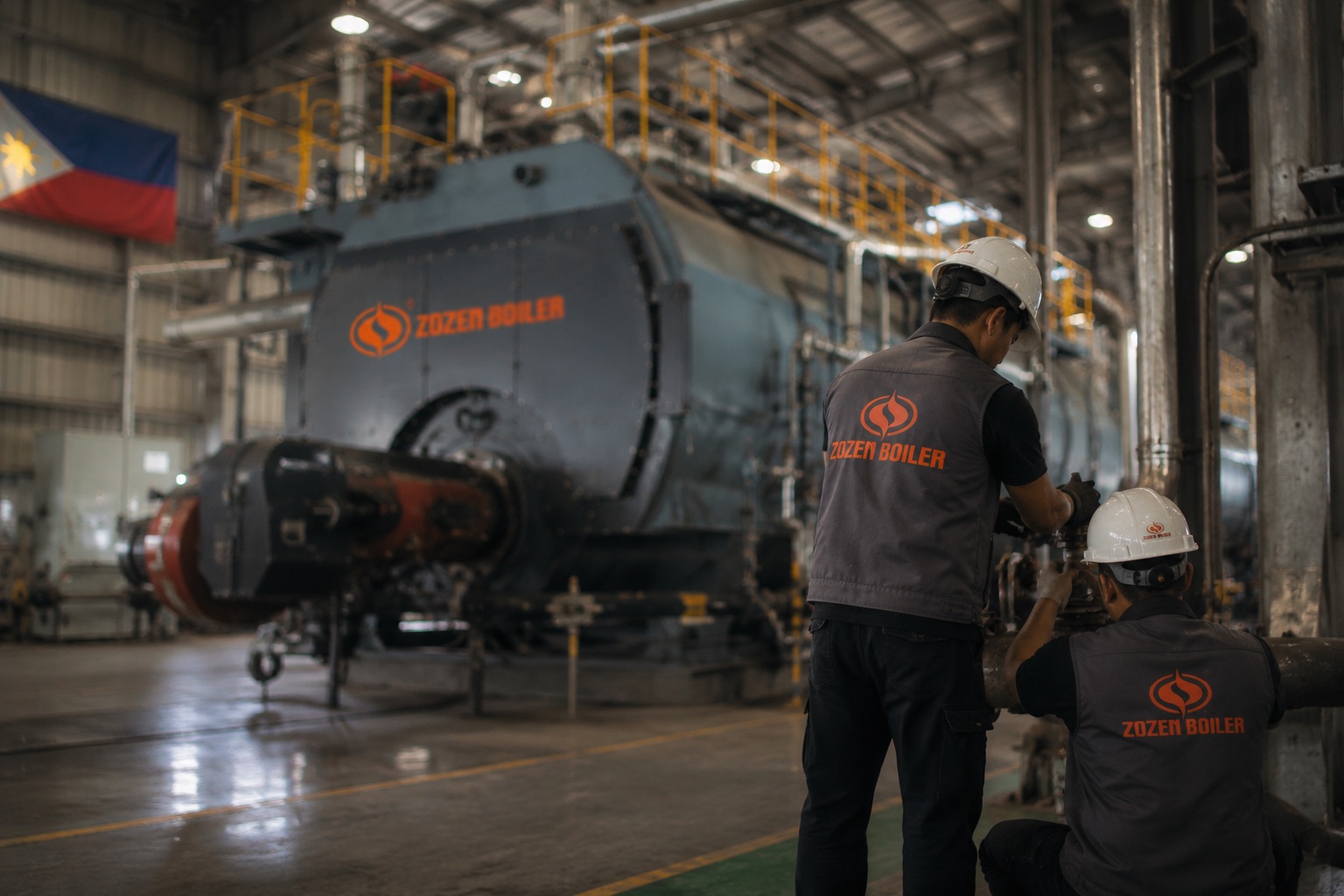
So ask any supplier the blunt question before you buy: which genuine parts for this exact model do you stock in the Philippines, and what is your typical time to get one to my site? At Zozen Philippines we stock genuine spare parts locally precisely because a part on a ship is not a spare part — it is a delivery. Our service page describes how parts support fits into the wider maintenance program.
the arithmetic of a plant stop
Put rough numbers on it yourself: take one day of your plant's lost production and compare it against the cost of a shelf of gaskets and gauge glasses. For most food plants, mills, and hotels, one avoided stoppage pays for years of spares inventory many times over.
Where downtime is truly expensive — food processing, hospitals — many owners go a step further and run N+1 boiler redundancy, which is common practice in those sectors. Spares keep a repair short; a standby boiler makes the repair invisible to production.
keep the shelf alive
A spares shelf only works if it is managed. Record what you use, reorder as you consume, and rotate stock so gaskets and glasses do not age out in storage.
Make the spares check a standing item in every preventive maintenance visit, whether yours run quarterly or yearly. Five minutes of counting parts against the list is the cheapest insurance in the boiler house.
Quick questions
What spare parts should a boiler owner keep on site?
Keep the consumables and fast-wearing items your own crew can fit: gaskets for every joint routinely opened, gauge glasses, sealing materials, and the fasteners consumed when manholes are opened for inspection. These items are inexpensive, are typically excluded from warranty as consumables, and cover most unplanned stoppages. Model-specific components such as burner and control parts are better held in your supplier's local stock.
How do I get a critical-spares list for my boiler?
Ask your supplier for a written critical-spares list at commissioning, while their engineer is on site with your exact configuration. The list should state which parts wear in typical service, roughly how often, and which have long lead times. File it with the boiler documents and review it during every preventive maintenance visit so it stays current.
Is stocking boiler spare parts worth the cost?
Usually, yes. Compare the cost of one day of lost production at your plant against the price of a shelf of gaskets, gauge glasses, and wear parts — for most plants a single avoided stoppage pays for years of spares inventory. In sectors where downtime is very costly, such as food processing and hospitals, owners often add N+1 boiler redundancy on top of a spares program.
Talk this through with an engineer
Tell us your process and fuel — we'll reply within one business day.