
What Your Boiler's Stack Temperature Is Telling You
Operations & Maintenance · 6 min read ·
The short answer
Stack temperature is the simplest single gauge of boiler health: every degree of heat leaving the chimney is fuel you paid for and did not use. A reading that creeps upward at the same load usually means fouled heating surfaces — soot on the fire side or scale on the water side. Economizers claw exhaust heat back; as a rule of thumb, raising feedwater temperature by about 6°C saves roughly 1% fuel, and condensing economizers can push a fire-tube boiler to efficiencies of up to about 98%.
There is one instrument on your boiler that tells you more about its health than any other, and it costs almost nothing: the thermometer in the stack. Every degree of temperature in the flue gas is heat that came from your fuel and left through the chimney instead of making steam.
Most plants glance at it. Few log it. That is a pity, because a stack temperature log is the cheapest efficiency monitoring program a plant can run — one number, once or twice a day, at a known load.
why the number matters
A boiler is a heat-transfer machine. Flame heat passes through tube walls into water, and whatever heat is left over exits with the flue gas. The hotter the exhaust, the more energy is escaping uncaptured.
So the stack temperature is, in effect, a live readout of how well the heating surfaces are doing their job. When the surfaces are clean and the burner is tuned, exhaust heat is at its designed minimum. When something degrades, the stack is usually the first place it shows.
the creep upward, and what it means
The key skill is comparing today's reading against a baseline — the stack temperature recorded at commissioning, at a known firing rate. Load matters: a boiler firing harder naturally runs a hotter stack, so always compare like with like.
A stack temperature that creeps upward over weeks at the same load usually means fouled heating surfaces. On the fire side, that is soot from imperfect combustion, common with oil and solid fuels. On the water side, it is scale from hard feedwater — the same insulating layer that, as a rule of thumb at about 1 mm thick, can raise fuel consumption by several percent.
Either way, the message is the same: heat is no longer crossing the tube walls the way it should. The response is cleaning — and, if scale is the cause, a hard look at the water treatment program before the tubes pay the price.
economizers: getting the exhaust heat back
Even a clean, well-tuned boiler sends usable heat up the stack. An economizer is a heat exchanger fitted in the flue gas path that captures some of it and uses it to preheat the boiler feedwater before it enters the drum.
The arithmetic is friendly. As a rule of thumb, raising feedwater temperature by about 6°C saves roughly 1% of fuel — heat the burner no longer has to supply. On a boiler running long hours, that percentage compounds into real money every month, which is why economizers typically pay for themselves quickly on heavily used units.
how far can it go? condensing economizers
A standard economizer keeps flue gas above the dew point. A condensing economizer deliberately goes further: it cools the exhaust until the water vapor in it condenses, releasing latent heat that ordinary designs never touch. This works best on clean-burning gas-fired boilers.
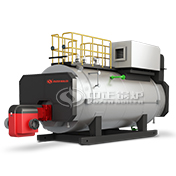
It is how modern fire-tube designs reach headline numbers — our WNS series three-pass wet-back boilers can reach efficiencies of up to about 98% when fitted with a condensing economizer. If you want to see where the economizer sits in the flue path, the 3D boiler builder on the Zozen site lets you explore the layout part by part, and the products catalog covers the range.
make it a habit
Log the stack temperature daily at a consistent load, alongside the water test results. Flat trend: leave the boiler alone. Rising trend: schedule a cleaning and check the water program before efficiency losses harden into tube damage.
It is hard to think of another five-second daily habit that protects both the fuel budget and the pressure parts at the same time.
Quick questions
What does a rising boiler stack temperature mean?
A stack temperature that trends upward at the same firing rate usually means the boiler's heating surfaces are fouled — soot on the fire side from imperfect combustion, or scale on the water side from hard feedwater. Both act as insulation, forcing heat up the chimney instead of into the steam. The usual response is surface cleaning, burner tuning, and a review of the water treatment program. Always compare readings at similar loads against a commissioning baseline.
How much fuel does a boiler economizer save?
An economizer uses flue gas heat to preheat boiler feedwater. As a rule of thumb, every 6°C or so of feedwater temperature gain saves roughly 1% of fuel, because the burner no longer supplies that heat. On boilers running long hours, the savings typically add up quickly. Condensing economizers go further by recovering latent heat from flue gas moisture, which is how some modern gas-fired fire-tube boilers reach efficiencies of up to about 98%.
Talk this through with an engineer
Tell us your process and fuel — we'll reply within one business day.