
Steam and Heat in Semiconductor Plants: Where Boilers Fit
Semiconductor & Electronics · 7 min read ·
The short answer
In a semiconductor plant, the core process tools — furnaces, implanters, etch chambers — run on electricity, not steam. Boilers serve the utility layer around them: cleanroom humidification, heated process water, chemical bath and cleaning loads, and facility hot water. Those loads are modest in temperature but unforgiving in reliability, which is why fabs specify redundant, tightly controlled steam plant.
With advanced electronics manufacturing being planned for Central Luzon, a fair question is arriving in Philippine engineering offices: what does a semiconductor plant actually need from a boiler house? The honest answer starts with a subtraction. The headline equipment in a wafer fab — diffusion furnaces, ion implanters, etch and deposition chambers — is electrically heated and precisely controlled at the tool. No boiler feeds those.
What a boiler does serve is the utility layer wrapped around the process, and in a facility that runs continuously, that layer is substantial.
the four loads that usually justify a boiler
First, cleanroom air. Cleanrooms hold humidity inside a narrow band, commonly somewhere around 40 to 50 percent relative humidity, because dry air invites electrostatic discharge and damp air invites condensation and corrosion. In the Philippine climate, air handlers spend most of the year removing moisture — but after deep dehumidification for temperature control, air often has to be humidified back up, and steam injection is the standard way to do it.
Second, heated process and cleaning chemistry. Wet benches, cleaning baths, and rinse steps frequently run above ambient temperature, and that heat is usually delivered indirectly through heat exchangers fed by steam or hot water rather than by heating the chemistry directly.
Third, water systems. Ultrapure water plants and their distribution loops need heat for certain treatment steps and for periodic hot-water sanitization of piping.
Fourth, ordinary facility loads that never appear in a process diagram but still have to work: canteen and washroom hot water, gowning-area comfort, laundry where cleanroom garments are washed on site.
why the specification is stricter than the size suggests
None of these loads are large by industrial standards. A plant that would look modest to a paper mill can still demand a level of reliability closer to a hospital. The reason is what a stoppage costs. Cleanroom conditions are qualified, monitored, and in many operations documented for customers; an excursion in humidity is not simply an inconvenience but a deviation that has to be investigated, and in-process material may be at risk.
That pushes specification toward duty and standby units with automatic changeover, generous turndown so a boiler can follow a load that swings between shifts, and controls that log conditions rather than merely maintain them. It is the same reliability engineering our team already applies in pharmaceutical and hospital plants, where the consequence of losing steam is measured in scrapped batches rather than lost tonnes.
fuel choice in an electronics estate
Electronics plants usually sit inside industrial estates rather than beside a fuel supply, which narrows the practical options. Where a gas connection exists, gas firing is the natural fit: clean, quiet, compact in the plant room, and easy to modulate across a load that changes with occupancy and production schedule. Diesel firing serves sites without gas, and remains common as a standby fuel.
Solid fuels rarely suit this setting. The fuel handling, ash, and space that make coal or biomass attractive to a mill are difficult to reconcile with a controlled-environment campus, and the steam demand is usually too small to justify them.
planning the boiler house early is cheaper than retrofitting
The most common regret in projects of this kind is not the boiler that was chosen but the space it was given. Plant rooms get sized late, after the process layout is fixed, and the result is a room that fits today's unit with no path for a second one, awkward access for tube cleaning, and a flue route that has to fight the building.
Sizing the heat plant while the process load is still being defined avoids all of that, and it tends to produce a smaller, cheaper installation rather than a larger one, because the boiler is matched to a real load profile instead of a padded estimate. That sizing conversation is the one to have first.
Quick questions
Do semiconductor fabs use boilers at all?
Yes, though not for the core process tools, which are electrically heated. Boilers in a semiconductor plant serve the utility layer: steam for cleanroom humidification, heat for process water and cleaning chemistry, hot-water sanitization of water systems, and general facility hot water. The loads are moderate in size but demand high reliability.
What size boiler does an electronics plant typically need?
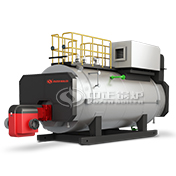
It depends entirely on cleanroom area, air-change rates, and how much wet processing happens on site, so there is no useful rule of thumb. Plants of this type usually fall in the packaged fire-tube range rather than requiring large water-tube plant, and are commonly configured as duty and standby pairs so maintenance never interrupts cleanroom conditions.
Why is redundancy so important for cleanroom steam?
Because cleanroom conditions are qualified and monitored. Losing humidity control is not just a comfort issue: it can trigger electrostatic discharge risk, force an investigation into whether product was affected, and interrupt qualified conditions. Duty and standby boilers with automatic changeover let a unit be serviced without the room ever leaving specification.
Talk this through with an engineer
Tell us your process and fuel — we'll reply within one business day.